Review by Tom Leeser
When reading Norman Klein’s essays and books, we become flâneurs, meandering through his personal landscape, viewing the past through critical representations of the present. His work reads like a cartographic template for time and space, drawn from an astute political, philosophical, cultural, and historical analysis. It’s an analysis that both destabilizes and aestheticizes, alerting the reader to the mechanisms that connect preceding events to our current data-driven age. His writing style breaches the divides of genre, blending memoir, history, theory, and fiction along the way. Klein describes his writing this way:
“I am a historian of memory/forgetting. Let me clarify briefly: memory/forgetting is a bit nonstandard as historical literature goes. Even the most careful research is curated fiction.”
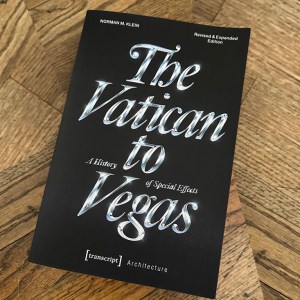
The Vatican to Vegas: A History of Special Effects is Klein’s latest work. It is a revised and expanded edition of the original 2004 publication, with a new afterword and appendix. As with the previous edition, the core premise of this update is a reconsideration of time and the continuing turbulence around technology and power, framed by what he calls “scripted spaces.” His extensive research forecasts a precarious future:
“The Future always blows off course, but the spaces that are supposed to respond to the future will often blow off course as well.”
The theorist and activist Franco “Bifo” Berardi writes about an “infinite present” in his book After the Future. Berardi defines the infinite present as an erasure of the future as a cultural and political narrative. The infinite present haunts Klein’s book, echoing throughout its chapters in accordance with his timeless history of “memory/forgetting.” Common temporalities and cultural histories are generated from a similar impulse, critiquing known facts of the present moment while dodging the fictions of a technological futurity.
However, Klein takes Berardi’s hauntology one step further by coalescing the styles of the European Baroque (1550–1780) with what is known today as the “Digital Baroque.” It is a parallel telling that aligns the analog past with the digital present, blown off course by a shared tendency for aesthetic ornamentation and socioeconomic disruption. He binds the Vatican’s Counter-Reformation during the Baroque period to today’s reactionary politics and the tech industry’s affluence and influence. As Klein writes:
“The Baroque comes out of hiding, but from unlikely places, with a very different message about power and the audience. This space is so subtle that it does not even require an atmosphere.”
The imagined future, the cultural present, and the historical past combine to form a timeless narrative that reveals itself through special effects. His chapters are a journey that takes us deep into the sensory immersion of special effects, revealing how their engineering is complicit in manufacturing our current political displacement. He weaves a complex web of temporal links, made apparent through the chapters’ forensic and rhetorical revelations. The book can be considered an archive of these revelations—a collection of historical paradigms that catalog our infinite instabilities. According to Klein:
“At the heart of these philosophical issues is a sense of codes themselves, how they are hidden, how they are turned into real space, how they are hinted at cautiously, and whether there is ever a codified version that applies as the ideal form of reception. So this is a fiction that is navigated by the audience as a fact of sorts.”
The scripted spaces of 16th and 17th century Europe through to today’s 21st-century global culture are defined by code, realized through an architecture and language of special effects. Special effects rely on methods of illusion, spectacle, and shock to fabricate virtual and artificial spaces and experiences. The intention behind the code is to take the audience outside of their bodies, transporting them into a heightened realm of awe, wonder, and at times—horror. Here, the link between the sanctified spaces of the Vatican and the profanity of Vegas is forged. In both cases, the mundane and the ordinary are relegated to the background. The audience’s “altered state” takes on the trappings of a transcendental experience—allowing the artificial to eclipse the real. When describing special effects, Klein says:
“Special effects were designed to suggest hoax; that enhanced their art. Still we can get considerable mileage out of the parallels between the Baroque and the Modern. They were an intrusive deception.”
The apparatus that defines the scripted space functions as a labyrinth spiral that is both immersive and subversive. These spaces bleed through the boundaries of the screen as they manifest their illusory and virtual domains. Baroque architecture and its painted domes function with the same intention as the casino’s enclosed confines, with their ever-present slot machines and roulette wheels. Both of these scripted spaces, the church and the casino, emit a vast and absolute control within a hallucinatory deceit. However, in the end—the house always wins.
Klein refers to the watchful eyes within these spaces as “happy surveillance”—an all-knowing, institutional voyeur. He defines “happy surveillance” as:
“A service that you pay for that will spy on you, to make you feel wanted. All scripted spaces involve a degree of collusion between the player and the program, a cheat code that encourages surveillance. No doubt, AI will intensify our love of being spied on.”
The Digital Baroque’s virtual surveillance systems are ubiquitous, driven deep into the channels of social media and the attention economy. In this particular moment in time, there is no need for walls, observation towers, or electrified fences. In today’s global culture, as inmates, we happily surveil ourselves consensually, leaving a trail of data crumbs for later collection and monetization. The spying and harvesting are done in the shadows—sight unseen.
Scripted spaces appear to us as magical, safe, and secure, but Klein points out that the real goal of the enchantment is the dissolution of the audience’s perception of natural reality and its subsequent shortcomings. These spaces are meant to provide an artificial reality that frees the audience from their manacles—it’s in an “escape room” with no exit. Klein writes:
“I could dress up Baroque “magic” as modernist. Special effects were designed to suggest a hoax. It was a strange hybrid filled with grandiose furnishings, with a theatricality, but guided by mathematical systems (solid geometry, perspective).”
The geometric perspective in Baroque painting can also be found in today’s Cartesian coordinate systems used to author new artificial realties—augmented reality, expanded reality and virtual reality. Klein prompts us to consider whether the special effects of the past and the present diminish cultural and political awareness of reality by exploiting belief and distorting the truth. Both periods can be accused of manufacturing artificial truths through their use of exaggerated drama, and emotional intensity amidst a strong intention to break down established systems. In this case, the profane and the sacred seem forever intertwined in a co-dependent endeavor.
In his view, “special effects were understood as a dialogical grammar, not simply as isolated moments of wonder.” He promotes this as proof that ideology is embedded in scripted spaces through special effects. Though the two epochs exist within different historical and cultural contexts, once we understand their mechanisms of persuasion, we can better understand their commonalities and then formulate a call to action.
In the book’s afterword and appendix, he outlines the conditions of a 21st-century Counter Reformation, where the political and corporate power structure exerts its influence, performing a masque disguised as authenticity—a behind-the-scenes cash grab. This form of duplicitous power exploits collapse through a media strategy of distraction, intimidation and confrontation. In the Digital Baroque, artifice and special effects are the theatrical devices, used by the attention economy to feed our perpetual desire machine.
The extended culture of digital “gamblification” through online sports betting and crypto speculation corresponds to the casino cheating us with the idea of easy winnings. Meanwhile, digital doomscrolling presents itself as an unconscious memento mori—till death do you part.
The techniques and systems that produce the special effects within scripted spaces are less illusional and more delusional. The selling of the pleasure principle combined with terror and fear invites Klein to articulate what he calls a state of “reverse imperialism.” We’re colonizing ourselves by thinking that the neoliberal infosphere will anesthetize us from our discontent, discomfort and pain.
Klein defines this process by describing it as:
“A kind of anxious hibernation, doomsday as a special effect, a scripted space loaded down with premonition but very little solidarity.”
The questions that emerge from the book go directly to the upheavals of power in the original Baroque and our contemporary polycrisis. The Thirty Years’ War and the state of our current forever-wars are also analogous. This articulation of power leads us to consider how in today’s world, violence is inflicted on the body politic remotely and asymmetrically through technology. The clouds that surround any future imaginary are just the beginning of the advancing storm.
The Vatican to Vegas: A History of Special Effects has provided us with new ways of rethinking and relearning time and the invisible systems that sustain our attachment to special effects. The book can be a used as a manual for decoding the scripted spaces that define our techno-feudalist ecosystem.
While I can’t address all the issues that Klein raises in his exposé of time, power and control, I can certainly say that I found his style and analysis to be cogent and at times prophetic. He confronts and confounds, but his provocative observations on culture, media, technology, and history are extremely valuable in this day and age. The text within the 530 pages bears witness to the heavy weather that lies ahead for all of us, locally and globally. By the book’s conclusion, our journey through his world comes to an end, but we are left with astonishment at the sheer volume of his revelations and his wit. We can depart his world with this last quote, a memory/forgetting mantra:
“The most precious world imaginable is almost nothing at all.”
The Vatican to Vegas: The History of Special Effects is published by Transcript Publishing.
Author’s Biography:
Norman M. Klein is a critic, urban and media historian and novelist. His books include: The History of Forgetting: Los Angeles and the Erasure of Memory; Seven Minutes: The Life and Death of the American Animated Cartoon; The Vatican to Vegas: The History of Special Effects; Freud in Coney Island and Other Tales; Bleeding Through: Layers of Los Angeles, 1920-86; The Imaginary 20th Century (also an online site); Tales of the Floating Class: Essays and Fictions on Globalization and NeoFeudalism. Both The Imaginary 20th Century and Bleeding Through were pioneering “database” novels—and docufables—that now have expanded new editions: Bleeding Through and The Vatican to Vegas: A History of Special Effects available online as well (from Transcript Verlag, Bielfeld). He also has published numerous essays across the arts, architecture, cultural history; along with numerous museum and gallery exhibitions.
 viralnet-v4.net