VIRALNET:
Let’s begin with you describing your recent show ‘Duets‘ at MC in Los Angeles
Stephen Vitiello:
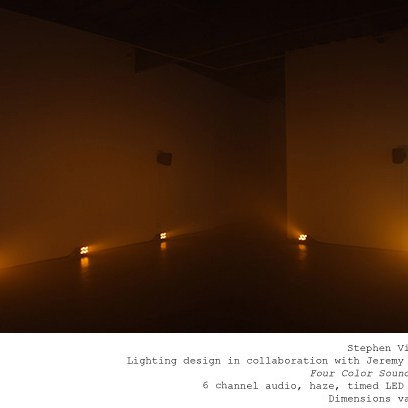
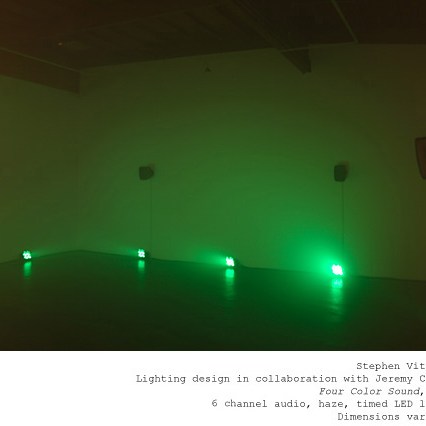
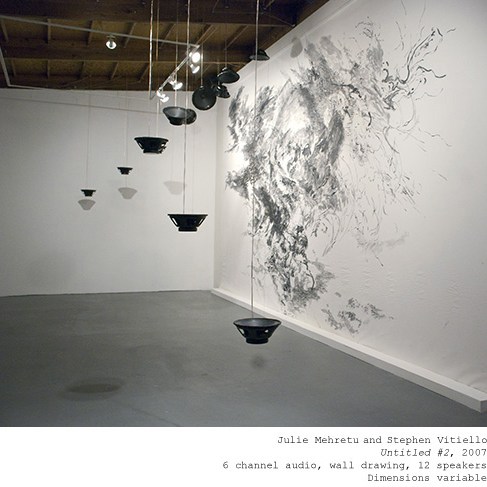
The show consists of 5 pieces. There are two big ones and three smaller works. The two big pieces are “Four Color Sound” which is from 2008 and “Untitled #2”, a collaboration with Julie Mehretu from 2006. Tony Oursler is the other primary artist I’m working with in the show.
“Four Color Sound” was commissioned by DiverseWorks in Houston, TX. DiverseWorks is a great non-profit, similar to The Kitchen with two black box spaces. I created “Four Color Sound” with a lighting designer from Houston named Jeremy Choate. The piece runs for 24 minutes and is broken into 4 sections: Blue, Red, Yellow, Green. Each section is connected to a color, which modulates sympathetically to the sound.
Each section of the sound composition consists of analog electronics mixed with some sort of natural sound. In Blue, there are sounds I recorded in the Brazilian Amazon. In Yellow there are musicians (flute, percussion, trumpet). In Green there are frogs. I can’t recall what’s in Red at the moment (!) …
VIRALNET:
As an artist working with sound, do you find you have a common language with the visual artists that you collaborate with or do you find that your approach to the issues of space and environment differ from theirs?
Stephen Vitiello:
Each collaboration is different. With Jeremy, I had a an idea of a “halo” of light. I described this to him and he brought in the equipment and in a sense, performed the lights to the sound, asking me for guidance and approval at certain points but at others, not so much. In this case, it was a collaboration but it was also ultimately my work. With the collaboration with Julie it was different, we were working as equal partners.
“Untitled # 2” was first commissioned by the theater director Peter Sellars for a festival in Vienna. Julie and I created the piece in the space. I started playing sounds for Julie, which she responded to with the wall drawing. This went back and forth for about a week, each one of us responding and editing, deleting, starting again. The suspended speakers in the middle were co-designed, in terms of the shape. Those speakers have low frequency tones that are below the threshold of human hearing. With this piece, it is really jointly created, and jointly credited.
Before we created the sounds or the images, we looked to find a common language. After days of talking, various visits and e-mails we realized that we both start with very recognizable sources but that we then transform them, often through layering so that the audience may never see that original source or sources …
Each collaboration finds a different common ground. I always say in my artist talks that my education as an artist was after college and it happened totally through collaborating with visual artists (Tony Oursler, Nam June Paik, Jem Cohen, Eder Santos) as well as musicians (Pauline Oliveros, Scanner, Andrew Deutsch). I absorbed so much of their processes, how they began with or without a concept, how they gathered footage and ultimately, how they composed their work through a post-production process. Each artist I worked with taught me something different. Nam June Paik definitely encouraged spontaneity. Pauline Oliveros of course encouraged listening. Tony Oursler taught me about dealing with space
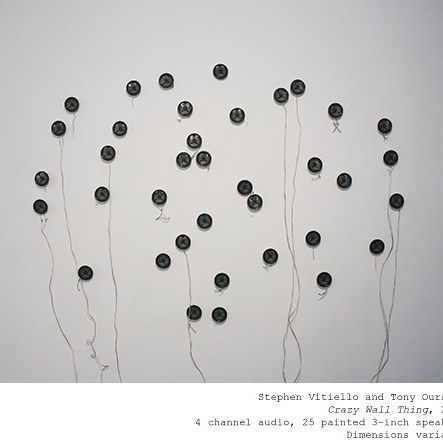
In the show at the MC gallery, “Four Color Sound” and “Untitled #2” are the primary pieces but there is also “Crazy Wall Thing” in the front office and a video and a series of photos in the back. “Crazy Wall Thing” started with my inheriting 40 or so 3″ speakers from Steve Roden. Steve had used them for a show at the Sculpture Center in New York and didn’t want to re-use them. I sent a bunch to Tony Oursler and asked him to do something with them. He painted the eyes on each speaker and turned them into faces with frowns. I was working on a track for a compilation at the time based on reinterpretations of Stockhausen’s “Gesang der Jünglinge” and it fit the faces. There is the sound of a choir mixed with electronics and then I took a field recording of a boy saying “pour some gasoline on it Dad!” and convolved it against the mix. The video in the back shows a performance with 70 parachutes with chimes dropped from a landing in the World Financial Center’s Winter Garden. That piece is another collaboration with a friend named Molly Berg. The photos are studies for graphic scores.
I’m also in a show at Steve Turner Contemporary in Los Angeles at the moment and Steve Roden is in that one as well. He and I are working on two collaborations for Marfa, TX at the moment.
VIRALNET:
I ask the question about collaboration because so often sound takes a ‘back seat’ to the visual. Many sound artists question and resist the premise of a visually dominant culture. But you have worked out a relationship with the visual that strikes a balance between the two senses.
Stephen Vitiello:
I try to stay aware of where sound should go in a project and where sound can go. If I am creating a soundtrack, then I stay aware that the visual will dominate and should in most moments. If it is my own project, I often eliminate the visual or do my best to create an environment in which it is clear that sound is the dominant focus. Of course you can’t tell people how to experience something but I do my best to bring the focus where I’d like it to go.
I do at times make pieces that are consciously visual but that still trace back to sound. For example, the ‘Speaker Drawings’ that I’ve shown. When I first started having gallery shows, I had people advising me. One was a gallerist who said she thought I should go out of my way to avoid commodity. Then there was an artist who thought I needed to find a way to make money (sound installations rarely sell) and that I should find a way to create visual works or objects that reflect my process of making sound. I’ve kept both of those models in mind and quite often, without thinking about it, have shows in which both concepts are represented.
I function as an artist in a museum and gallery world that of course is visually dominated. I think that that same audience doesn’t generally know how much it actually is audio/visually dominated. I overheard an important video curator say once that she worked at a visual arts institution. It’s impossible for me to think of video for example as anything but connate. Its nature is made up of both audio and image.
VIRALNET:
The one thing that strikes me about your work is the transformative quality of the field recordings. ‘Smallest of Wings’especially. I know that there is quite a history of field recordings in 20th century sound practices- but your work takes on a different aspect- one that seems to deal with sound as a portrait of itself in the making. Can you talk about your approach and if you see differences or similarities to the history of the practice.
Stephen Vitiello:
One thing about the way I work is that I don’t have one absolute way that projects should be done. Meaning, in some cases, field recordings remain relatively untouched, unprocessed. In other cases, they are manipulated a great deal. I was just writing a book review of the new book on the San Francisco Tape Music Center and found that I felt much more connected to their open approach to sounds, compared to the Musique Concrete groups or the Stockhausen camp.
Each experience calls for a different approach, a different way of treating the sound. The sounds in the World Trade Center project, or recordings in the Brazilian Amazon stood on their own and in so many words, they told me not to do too much. On the other hand, contact microphones on Donald Judd sculptures called out for manipulation, play and trickery.
‘Smallest of Wings’ was first a small gallery piece in 2005 and then a gigantically amplified, all new piece for the outdoor installation in London at Broadgate Arena. I wanted to do all that I could to work with movement of these small sounds — bird wings, recorded very close up and moth wings fluttering about. In London, I had a unique opportunity of a large budget and access to an amazing audio engineer, named Alban Bassuet who could push what I am able to do with spatialization and routing to a whole new level. More than anything, I wanted to give people a sense of wonder and hopefully pleasure from these small events that we usually ignore.
VIRALNET:
Your description of “Smallest of Wings” really addresses the transformative quality of your work that I mentioned earlier.
Stephen Vitiello:
That makes sense. I think a lot of artists have a couple of pieces that they keep making with different titles. “Smallest of Wings” is one that I was working on through other projects for several years. Maybe if you look closely you can see “Smallest of Wings” in two or three other pieces, if you look (and listen) really carefully.
One point about transformation too is that I try to vary how I transform sounds. At times, I am tied to the computer but at other times, I try to create real-time processing environments. Lately, I have been using a modular synthesizer to process sounds on the fly. Some other projects though have hours of editing. I can’t imagine doing this with tape and a razor blade as people did for many years but I’m sure that’s what I would have done if it was the sole option.
VIRALNET:
When we listen closely we are first seduced by the appearance of simplicity in your recordings — only to be taken to another level of complexity that leaves us in a state of awe… I think you’ve described how this is done technically- but what about your composition process ?
The World Trade Center piece in particular does this for me…
Stephen Vitiello:
The first part of the process is based on listening — whether being out and doing field recordings or using the synthesizer, feedback or having musicians create tracks for me. As those events are being recorded, you recognize important moments. Next is to work on concept and a basic plan. From there, I do a lot of layering and then slowly take away the layers until something remains that I feel good about.
With the World Trade Center recordings, it took some time to get the mics to work — to figure out the technology. Once I had the sound, I had a bit of insecurity that I needed to make an installation.
So I started trying to change things or do things to my studio space. In the end, I realized that the best thing I had was the recordings and that people didn’t need to see anything artificial, beyond the image of those contact microphones taped to the windows, and all that the windows revealed, which of course changed minute to minute, day to day.
When I’m teaching, I often use the analogy of “pick up sticks.” You start with a pile of stuff and start pulling away, getting more sensitive as you go and hoping to find something great, maybe fragile, maybe not at the bottom of the pile of sticks — be it a visual form or concept or in my case, a sound.
VIRALNET:
I like the “pick up sticks” analogy… Your work also investigates different aspects of nature — in particular the piece ‘Tetrasomia’ — has the five natural elments — earth, wind, fire, water and ether. How do you think of sound and it’s relationship to nature — is there a ‘sacred geometry’ to the number of elements in ‘Tertrasomia’?
Stephen Vitiello:
‘Tetrasomia’ was really the beginning of a transition for me — starting to hear the world outside of NY! With that one, it first occurred to me since I was looking to the web to find archives of environmental sound, rather than going out and recording the sounds myself! I wanted to use that project as an organizing/mixing system. I’m not sure if I was thinking of a “sacred geometry” but it was definitely a moment where my ears were starting to open.
The thing for me is that I’ve come to love the experience of listening to different natural environments, whether it’s with a microphone or without, but usually with!
I love the strangeness of tones and the rhythms of frogs that sound like drunken old men or manic insects. It’s very solitary and not lonely to be out in a field with headphones on and a nice microphone. I love listening to how those sounds (frogs for example) sound in that moment, but also in that place, that context of location and how the light and the sounds change over time — whether it is going from day to night (as I worked with in the Yanomami recordings) or just what happens when a plane flies over and the birds stop or start, or mostly stop but one lonely bird or frog keeps going.
‘Tetrasomia’ was part of that but also a trip to Death Valley many years ago and the beautiful (relative) silence that allowed a single sound to stand out really affected me… just as much as the drones of traffic, people and machines did growing up in NYC.
There’s a really nice essay by Bill Viola in the issue of Leonardo Music Journal, dedicated to David Tudor and Composers Inside Electronics where he speaks of a similar appreciation of being out in a field of frogs
Something that is in your question about ‘Tetrasomia’ is something that I’m not often aware until after a project is done — which might be the spiritual nature of a project or the political. Those things don’t consciously drive my work but sometimes you look back and realize that they were present or are present in the final piece
VIRALNET:
I think that there are things that are embedded in a work that are only revealed through the process of making. They are also revealed by the social context that we experience them in after they’re made.
Stephen Vitiello:
I agree.
VIRALNET:
I think we covered a lot of ground, Stephen — do you want to conclude with a final statement?
Stephen Vitiello:
Actually, I’m not sure how to conclude! I can only say that I feel excited that I keep getting to make exhibitions and new CDs. I’m never sure how much of an audience I find but I do think it grows slowly. It’s pretty amazing how much the field(s) of sound art have grown in recent years. There are several overlapping histories that go back 100 years or more but recent technologies have made making work, recording, editing, mixing so much more accessible. I’m amazed at the number of people who are doing field recording for example — and putting those sounds to so many different uses. Sometimes it pushes me to think I should find a new way of working but those things never happen when you force them. It’s more like the changes catch you by surprise and suddenly you’ve found a new direction. On the other hand, I’ve had a chance to listen to such a small part of the world, so field recording could stay satisfying for the rest of my life!
I’ll sign off now. Speak to you soon!
VIRALNET:
Thanks Stephen!

