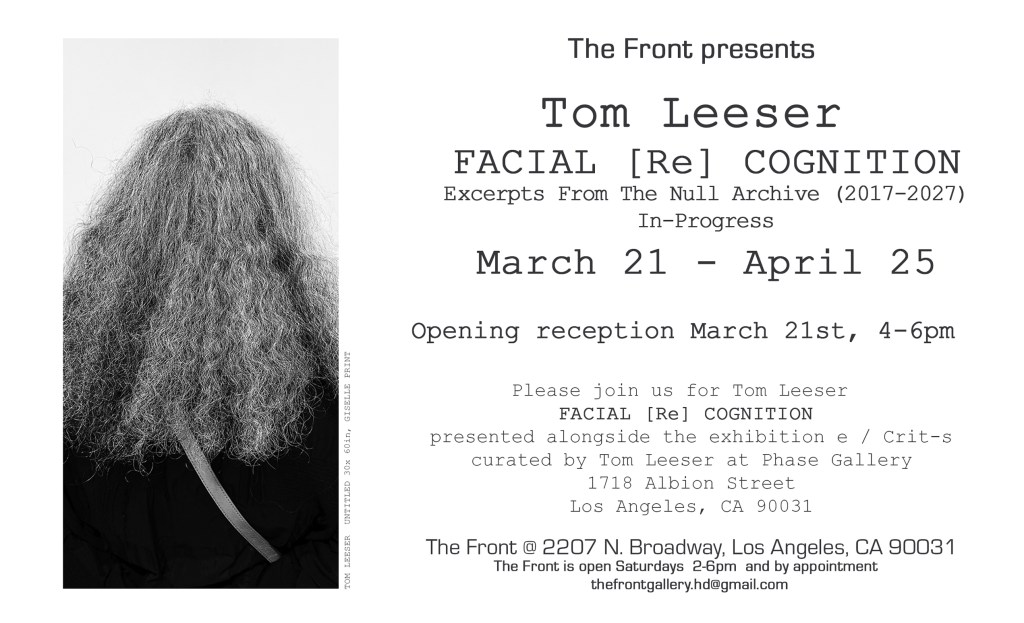
Tom Leeser
FACIAL [Re] COGNITION
Excerpts from the Null Archive (2017-2027)
In-Progress
March 21 – April 25, 2026
The Front @ 2207 N Broadway, Los Angeles, CA 90031
An exhibition of selected images from the “Null Archive: Ways of Seeing/Ways of Becoming/A Personal History of Photography and Cinema Found in an Everyday Life” at The Front, Los Angeles, California,
“Photography is modernity run riot”
—Allan Sekula, “The Body and the Archive”
My cultural practice as a media artist spans writing, curation, image/sound production, interactive installation, Internet-based projects, social inter-actions, public art, gaming and education. In 2012, (A)Provisional Collective was founded with the intention of exploring temporary experimental practices that can occur collaboratively in and around public media spaces, alternative cultural and academic institutions, galleries and in our everyday encounters and environments. This multidisciplinary practice has engaged topics such as climate change, education within a radically progressive context, cultural memory and speculative futures. The point of the practice is to perform within the critical gap between art and life through a reconsideration of media aesthetics and the body politic.
“Facial [Re] Cognition, Excerpts from The Null Archive: Ways of Seeing/Ways of Becoming/A Personal History of Photography and Cinema in an Everyday Life,” is a small part of a larger durational performance that was started in 2017. It will manifest as a 10 year archive of digital images using an array of pedestrian mobile phone cameras. The work explores space, movement and time through the process of lived experiences, bridging the acts of seeing and recording within the constricted aspect ratio of 2.5” x 4.4”. The images are vertical, black and white and should be considered within the context of a fractured form of cinema, composed of representations and abstractions. The archive, though made up of still images, is meant to be forensically explored as a time-based medium when completed; a collection of “frames” rather than photographs, composed through an anti-forensic discontinuity of memory and forgetting (without the use of AI.) It is a performance that takes place as a private enterprise, a soliloquy of sorts. This particular exhibit is a collection of secrets whispered sotto voce. It echoes the Latin roots, solus, to be alone and loquor, to speak to oneself. Also, the critical aspect of this particular exhibition pays homage to the idea that the face is both the fundamental point of identification and at the same time, a disguise hiding an alternate form of the self.
In Sekula’s essay, that is quoted above, he formulates an argument that the “danger” from photography is not just the “numerical proliferation of images” but also its “incendiary leveling of the existing of cultural order.” [1] It’s not a surprise, that in 2026, media saturation and the ever expanding use of Large Language Models (LLMs) and Neural Networks have led to a sociopolitical cacophony that has decentered and devalued communication, while overvaluing and extending authoritarian tendencies within a network of global and local capitalism.
The archive itself is a response to this current condition. It uses digital technology as a means to reassert personal meanings and chance encounters that amplify embodied experiences through the act of “recording.” The images can be labeled as recordings, given the process that encompasses their making. The making evokes a means to diminish the separation between the media and the self. In this case, the “way of seeing” constitutes a critique of the mass distribution and transactional nature of online viral content. There is a “suchness” born out in the process, one that is mimetic of meditation. The images are not conceived or planned, they are a result of being in the right place at the right time. Of course, photographers have been working in this mode since the nineteenth century, however, the “détournement” lies in the intention to amplify the performative component, frame it within an exaggerated time line and to link these aspects to the articulation of a common meaning through an archival process, meant to reflect a simple creative act. It takes Guy DeBord’s idea of psycho-geography and Baudelaire’s flaneur and blends them within an alternate form of digital culture.
Another influence on the project was the essay, “The Conspiracy of Art” [2] by Jean Baudrillard. In the essay, Baudrillard refers to the idea that the real has been replaced by the simulacra, resulting in a state where art has been erased from daily life, resulting in a “null” or empty state. Thus the name, “The Null Archive.” However, rather than abandon art completely, he took up photography and exhibiting in commercial galleries.It was during one such exhibition that I came across his photographs of innocuous scenes, taken with no apparent direction or intention. They came across as empty records “sightings.”
In addition to considering Baudrillard’s critique of the null, the performative aspect of the archive provokes another critical questioning. Echoing Allan Kaprow, the process of questioning becomes an encouraged action, a continuous event that could bridge the gap between art and everyday life itself, between viewer and author.
Reading the Diamond Sutra, Buddhism takes another view of “emptiness” or the null. The text states that all phenomena are illusory, empty of “real” existence. It advises us to take a view of non-attachment to the individual self and to material form. [3] It is through these references to the null that meaning within the archive emerges. In recording the images, a state of aesthetic experience activates the paradoxical idea of a contingent self in an empty or null condition. The basic ground of the process is designed to eliminate the illusory separation between the medium and the artist.
There was also a determined intention, to play off the term, “cinema verite” and replace it with “a record of verites.” A “verite” of experience rather than proclamation. A collection of inter-related individual images rather than a reel of contiguous film. Within this context, the portraits in the exhibition are taken of people I met by chance and I know personally. There are also images of statues and memorials of people that I never met or existed in “real life.” These two categories of images are juxtaposed, reflecting back to the Diamond Sutra’s contention that a true individual self is not essentially existent, rather it is a way of becoming. The recorded images are a “snapshot.” A moment in space and time in a life that will vanish in the afterglow of a future absence.
Notes
[1] October , Winter, 1986, Vol. 39 (Winter, 1986), MIT Press p.4
[2] The Conspiracy of Art, 1996, Jean Baudrillard
[3] The Diamond Sutra, Shambhala Publications, p. 43

